
Harrison.ai: Building a Global Clinical-AI Company from a Mission-Led Australian Founding Team
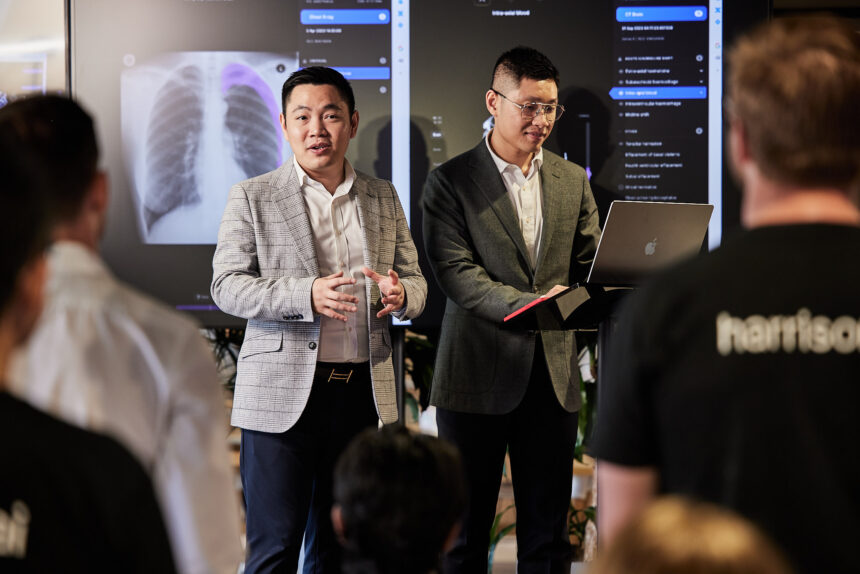
Harrison.ai has become one of the strongest AI companies to emerge from Australia because it was built around a real healthcare bottleneck rather than a generic machine-learning thesis. The company says it was founded in 2018 by brothers Dr Aengus Tran and Dimitry Tran, with the belief that technology could help make quality healthcare more available and more equitable at scale. Today, Harrison.ai describes itself as a global healthtech company focused on AI-powered diagnostic support and workflow solutions in radiology and pathology, with growing reach across Australia, Europe, Asia and the United States.
The founder background gives the company unusual depth. Harrison.ai’s own long-form founder profile on Aengus says he grew up in Vietnam in a family deeply shaped by maths and education, later studied medicine in Australia, and became increasingly convinced that the world’s healthcare problems could not be solved by clinicians alone. The same profile says his brother Dimitry brought the business and execution lens to the company’s formation, giving Harrison.ai a founding structure that combined clinical credibility with commercial ambition from the beginning. That pairing still feels central to the way the business presents itself today.
That origin story matters because Harrison.ai never really looked like a conventional enterprise-software startup. The company has consistently framed its mission less around “AI transformation” in the abstract and more around the specific pressures facing modern healthcare systems: clinician shortages, rising imaging volumes, delayed diagnosis and growing workflow complexity. Its public materials say the goal is to expand clinician capacity, improve operational efficiency and support earlier disease detection, which is a more grounded and useful framing than many AI-healthcare companies manage.
The company’s capital journey also shows how that thesis has matured. In February 2025, Harrison.ai announced a US$112 million Series C, saying the round would support accelerated expansion into the United States and broader scaling of its AI-powered diagnostic and workflow products. Its About page now says total capital raised exceeds US$240 million, which places it among the more heavily backed private AI companies in Australia and underlines how much investor conviction has accumulated around the platform over time.
Importantly, that capital was raised against a business that was already showing a more coherent product architecture than many medtech AI peers. In 2025, Harrison.ai unified its identity more clearly by bringing together its radiology and pathology businesses under a single brand, with earlier entities such as Annalise.ai and Franklin.ai tied more explicitly into one platform story. The company described that unification as a way to simplify how customers engage with it and to accelerate global growth across medical diagnostics. That matters because it suggests the business is moving beyond a collection of promising products and into something more integrated and scalable.
The radiology side of the business appears to be the strongest proof point so far. Harrison.ai says its technology is used across 40+ NHS Trusts in the UK, by more than half of Australia’s radiologists, in every public emergency department in Hong Kong, and with customers in Europe and the United States. Those kinds of deployment claims are significant because they indicate the business is operating well beyond pilot-stage experimentation and into routine clinical workflows in major health systems.
The partner ecosystem adds another layer of credibility. In late 2025, Harrison.ai announced a strategic partnership with Apollo Radiology International, describing the company as one of the world’s largest and most advanced teleradiology groups. The partnership was framed around using Harrison.ai’s chest X-ray and brain-CT diagnostic support tools to strengthen Apollo’s global reporting capabilities. That is exactly the sort of collaborator that makes a clinical-AI story feel more substantial: not just a health system trying a new tool, but a specialised radiology operator integrating the technology into a scaled service environment.
There is also evidence of validation at the product-performance level. Harrison.ai’s site includes published evaluation work on specific diagnostic models, including studies on obstructive hydrocephalus detection and intracranial findings on head CT. That does not make adoption automatic, but it does show the company trying to support its commercial story with clinically meaningful evidence rather than relying only on marketing language. In healthcare AI, that distinction is critical.
The challenge for Harrison.ai is that healthcare remains one of the most difficult markets in technology. Procurement cycles are long, integration burdens are high, trust has to be earned with clinicians, and even strong products can stall if the workflow fit is weak. But Harrison.ai’s current shape suggests it is navigating those realities from a position of unusual strength: mission-led founders, significant capital, evidence-backed products, and a growing network of real clinical customers and partners.