
City of Joondalup: Building a More Investable, Connected and Experience-Led Municipality
Per your direction, this replaces the ReadyTech slot with a municipal government profile rather than another listed company.
The City of Joondalup presents itself as one of metropolitan Perth’s most important local-government centres, located in the rapidly expanding north-west corridor with a strategic role across community services, coastal development, economic activation and city-centre planning. In its FY2024–25 Annual Report, the City said the purpose of the report was to show achievements, challenges and future plans against the long-term vision in Joondalup 2032 and the priorities in its five-year corporate business plan.
That long-term framing matters because Joondalup is trying to be more than a service-delivery municipality. The City’s strategic language is about shaping a “global city” that is bold, creative and prosperous, with a stronger economic base, better-connected precincts and a more attractive environment for residents, businesses and visitors. In that sense, the City is operating with a placemaking lens as much as a governance one.
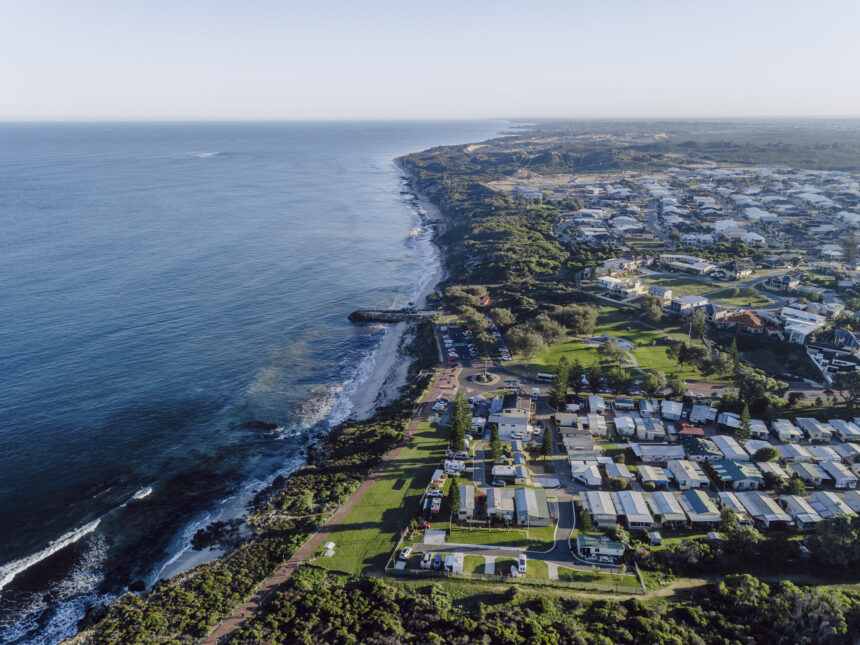
One of the most visible expressions of that ambition is Ocean Reef Marina. In its annual report, the City said it continued supporting DevelopmentWA in delivering the Ocean Reef Marina, providing technical input for approvals and helping ensure stakeholder alignment with the development agreement. In the year-ahead section, the City described the marina as a DevelopmentWA-led project and said construction continued on a world-class waterfront precinct offering recreational, tourism, residential and boating facilities.
The partner ecosystem around Ocean Reef is particularly strong. A City-linked development agreement says the project involves the City of Joondalup and DevelopmentWA, while broader project coordination also touches agencies such as the Department of Transport, Department of Planning, Lands and Heritage, and Water Corporation. For a municipal profile, that is exactly the sort of cross-agency partnership that shows how local governments can play a catalytic role in major precinct delivery.
Joondalup’s City Centre agenda is another key part of the story. The annual report said strategic planning and business-case development progressed during FY2024–25 for future City Centre opportunities, with a probity adviser appointed, a governance framework presented to the Major Projects and Finance Committee, and procurement commencing for a feasibility and market-analysis consultant. The City said that work strengthened the foundations for urban growth and investment attraction in the Joondalup City Centre.
That emphasis on investment attraction is not abstract. A City investment document describes the Joondalup City Centre as a recognisable business district supported by innovation, technology, education and health-industry clusters, with a role in increasing vitality, vibrancy and employment. The annual report’s stakeholder mapping reinforces that picture, naming Edith Cowan University, Joondalup Health Campus, North Metropolitan TAFE, Lakeside Joondalup Shopping City, the Joondalup Business Association and DevelopmentWA among the organisations it works with to shape outcomes.
That cluster effect is one of Joondalup’s strongest editorial angles. Many municipalities talk about growth in broad terms, but Joondalup can point to an existing constellation of higher-education, health and business assets already in place. The City’s own materials describe the city centre as a learning and innovation hub, which gives its economic-development story more depth than a standard “regional growth” narrative.
A more contemporary extension of that is the Joondalup Innovation Precinct. The City says it is establishing a city-centre-based technology and innovation business incubator in partnership with Spacecubed, aimed at promoting entrepreneurship, innovation and economic growth in the region. That initiative matters because it suggests Joondalup is trying to create not only better places, but also stronger pathways for local business formation and knowledge-sector activity.
The City’s project story is not only about large strategic precincts, though. Its FY2024–25 report highlighted the Duncraig Adventure Hub as a A$9 million investment in outdoor recreation and community wellbeing, and the projects dashboard says the hub is designed as a multi-use space at Percy Doyle Reserve with youth-oriented recreation features and a wider community role. These sorts of projects are important because they keep the municipal story grounded in visible, everyday public value.
Joondalup also appears increasingly aware that activation matters as much as hard infrastructure. In the year-ahead section of the annual report, the City flagged a pop-up piazza in the city centre to provide a convertible performing-arts space that supports cultural activity, precinct activation and the creative economy. It also said event attraction would remain a priority because events support tourism, local business activity and community engagement.
That activation model is already visible in public-facing programming. For the 2026 Valentine’s Concert, the City said the event was made possible with support from major partners Edith Cowan University and Joondalup Health Campus, with Joondalup Resort as venue partner. For Little Feet Festival 2025, the City said the event at ECU Joondalup was sponsored by major partner St Stephen’s School. Those are small examples in strategic terms, but they show a municipality comfortable working through partnership rather than trying to deliver everything alone.
The City’s wider stakeholder map backs that up. Its annual report names organisations including Main Roads WA, WA Police, the Chamber of Commerce and Industry WA, Edith Cowan University, Joondalup Business Association, Joondalup Health Campus, Lakeside Joondalup Shopping City, North Metropolitan TAFE and DevelopmentWA as part of the network it engages through collaborative forums, partnerships, sponsorships, policy input and events. That is a broad coalition for a municipal government, and it helps explain how Joondalup is trying to punch above its administrative weight.
The challenges are real as well. The City’s own reporting points to the need to balance community priorities, major-project governance, infrastructure delivery, investment attraction and service expectations across a diverse stakeholder base. It also acknowledges that some projects are still in planning, procurement or phased construction rather than fully complete.
But the tone of the reporting is notably constructive. Joondalup’s materials do not read like a council standing still or reacting passively to growth; they read like a municipality actively trying to shape where investment, culture, recreation and city-centre development go next. That is one reason the profile works so well. The City is not being presented merely as an administrator; it is being presented as a local enabler of place, partnership and momentum.
What makes the City of Joondalup especially strong as a feature is that its partner network is unusually visible. DevelopmentWA at Ocean Reef Marina, Spacecubed in the innovation precinct, Edith Cowan University and Joondalup Health Campus in activation and ecosystem building, and organisations like Main Roads WA and the Joondalup Business Association in broader city-shaping work all say something substantive about how the municipality operates.
Joondalup today looks like a municipality with a stronger civic-development identity than many of its peers. It has major waterfront ambition, a credible education-and-health cluster, a live city-centre agenda and a practical record of delivering community projects while drawing in public and private collaborators. For a Government-sector profile, that gives it a strong and distinctly modern story.