

Australian Vintage: Repositioning a Global Wine Platform Through Brand Strength, Partnerships and Smarter Channels
Australian Vintage is not trying to be a niche winery, and that is part of what makes the company interesting. It describes itself as an ASX-listed, B Corp Certified Australian wine and drinks company with a portfolio of globally recognised brands, products sold in more than 40 countries and production infrastructure that includes Buronga Hill Winery, the third-largest winery by crush capacity in Australia. In its FY25 presentation, the company said FY25 revenue was $257 million and highlighted trusted relationships across the entire value chain as one of its core strengths.
That broad platform matters because Australian Vintage is working across branded consumer wine, no- and low-alcohol categories, ready-to-drink innovation, packaging flexibility and export channels. Its home and about pages stress consumer-led innovation, while investor materials frame the company as a globally recognised wine business rather than a purely domestic label owner. The portfolio includes brands such as McGuigan, Tempus Two, Nepenthe, Barossa Valley Wine Company and newer innovation plays like Poco Vino.
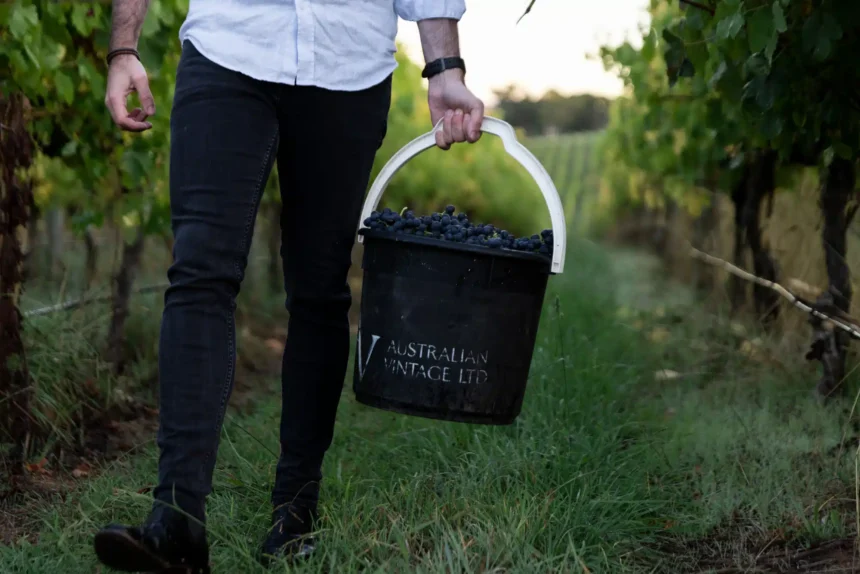
The operating base behind that brand portfolio is substantial. On its winemaking page, Australian Vintage says Buronga Hill Winery in the Sunraysia district is equipped with state-of-the-art technology and has capacity that places it among the largest wineries in the country. A 2025 feature on the winery added that the site employs more than 140 permanent staff plus over 80 seasonal workers, with additional support from Grand Junction Vineyard and sister operation Merbein Packaging.
That production scale is useful context for the turnaround story the company is now telling. FY25 was still a year of adjustment: the FY25 Appendix 4E reported total operating revenue of $257.2 million, down 1%, but also showed materially improved earnings metrics relative to the prior year. The company’s own update in May 2025 described AVG as being in the early stages of a turnaround to address declining sales and negative cash outflows from earlier years.
The positive framing is that the business is becoming more brand-led and margin-aware. In its 1H FY25 results press release, Australian Vintage said branded sales had risen to 80% of total revenue, up from 65% in FY20, and that premiumisation and innovation had increased to 26% of revenue and 37% of margin. The same release said McGuigan Zero remained the number-one brand in the UK no-and-low segment, while McGuigan Mid was leading the mid-category there.
That emphasis on no- and low-alcohol categories matters because it shows Australian Vintage trying to stay close to changing consumer behaviour rather than relying only on legacy portfolio strength. Its FY25 presentation described the company as the number-one global leader in no and low alcohol, while its brand portfolio and investor updates continue to spotlight innovation as a lever for future growth.
Partnerships are an increasingly visible part of how the company is trying to accelerate that strategy. In May 2025, Australian Vintage announced a strategic partnership with Burch Family Wines that will see it acquire international ownership of the MadFish brand, become the exclusive distributor of Howard Park Wines in the UK, Ireland, Europe and Canada, and enter into a long-term sourcing and processing partnership with Burch Family Wines to support MadFish. That is a particularly strong example of a capital-light expansion model in action.
That Burch deal is important for more than the brands involved. It shows Australian Vintage leaning on its existing distribution, bottling and customer relationships to scale premium Western Australian wine in offshore markets without having to build everything from zero. CEO Tom Dusseldorp explicitly framed the agreement as an example of capital-light growth through partnerships and innovation, which fits the broader reshaping of the business.
The distribution network on the export side is also becoming more visible. In the 1H FY25 results release, the company said strengthened relationships with COFCO and Oceanus were expected to help drive double-digit growth across China and the rest of Asia. That matters because it suggests the Asian growth story is not just about generic market optimism; it is being pursued through named channel relationships with established regional players.
Brand partnerships closer to the consumer are adding another layer. In July 2025, Australian Vintage announced that McGuigan Wines had become the official wine partner of Cricket Australia under a multi-year arrangement, with activations ranging from national promotions to co-branded product and match-day experiences. For a business focused on strengthening brand relevance, that is the sort of partnership that can extend the reach of a flagship label well beyond the traditional wine aisle.
The company is also using similar partnerships across other labels. Tempus Two has been named official wine partner of PayPal Melbourne Fashion Festival, and news coverage on the company site highlights other event-led brand activity. These relationships are not the whole strategy, but they do show Australian Vintage trying to connect its brands to culture, lifestyle and occasion-based consumption in a more deliberate way.
Operationally, Buronga Hill is becoming part of that future-facing story too. The winery feature published in 2025 says more than 55% of the 2025 crush came from locally grown Sunraysia vineyards, and that the site has shifted to 100% renewable energy through Flow Power. In a company where supply chain, sustainability and production efficiency are all increasingly material, those details help connect the consumer brand story back to real operational infrastructure.
The challenge section for Australian Vintage is best framed as repositioning rather than distress. Public filings still reflect legacy inventory and cash-flow pressure, and the statutory result remained under strain in FY25. But management has been consistent in pointing to inventory reduction, improved cash performance, stronger branded mix, premiumisation and innovation-led launches such as Poco Vino as the route forward.
There are also external signs that the reset is gaining traction. Australian Vintage said it won two major prizes at the 2025 Australian Drinks Awards, including recognition for supply chain management, and it has also made its B Corp credentials more central to how it presents the organisation. That combination of commercial discipline and ESG positioning is increasingly important in consumer goods businesses trying to modernise their identity.
What makes Australian Vintage a strong feature is that its partner network is unusually visible for a wine business. Burch Family Wines, Howard Park, COFCO, Oceanus, Cricket Australia, Flow Power, Grand Junction Vineyard and Merbein Packaging all reveal something concrete about how the company is operating — across sourcing, processing, brand-building, energy, export and channel development.
That is why Australian Vintage now reads less like a traditional wine company and more like a brand-and-platform business in transition. It still carries the complexity of a turnaround, but it also has real scale, recognised brands, meaningful export reach and a growing set of partnerships that can help it expand without overstretching the cost base. On that basis, the company looks increasingly like a business rebuilding with more focus and flexibility.