

Guzman y Gomez: Scaling an Australian-Founded QSR Brand Through Drive-Thrus, Franchise Discipline and Bigger Daypart Ambition
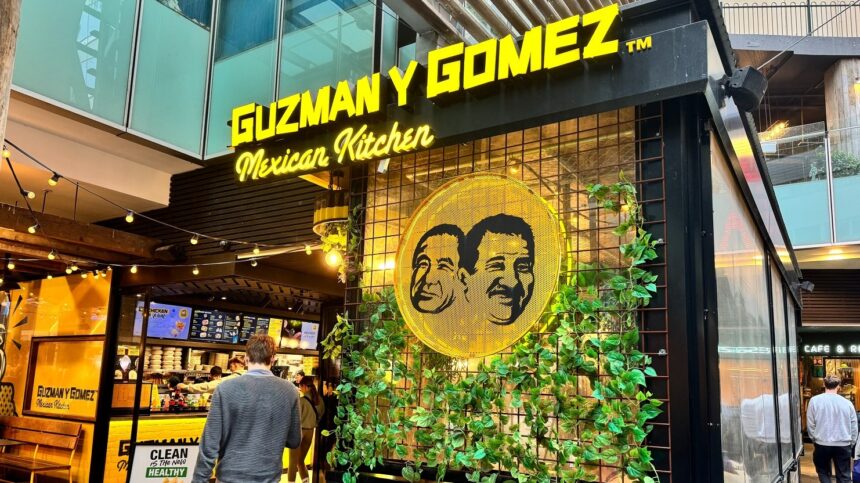
Guzman y Gomez now occupies a distinctive place in the Australian restaurant landscape. Founded in 2005, the business has positioned itself as a fast-growing quick-service restaurant chain built around fresh, made-to-order Mexican-inspired food, with a stated mission to “reinvent fast food and change the way the masses eat.” By FY25, its first full year as a listed company, GYG had become one of the clearest Australian-founded restaurant growth stories on the ASX.
What gives GYG more substance than a simple growth-brand narrative is the quality of the operating model now sitting underneath the brand. In its FY25 annual report and results materials, the company said it crossed $1.2 billion in network sales for the first time and had approximately 256 restaurants globally by 30 June 2025. That matters because it shows GYG is no longer a small challenger concept; it is already a scaled restaurant system with meaningful domestic density and an expanding international footprint.
The Australian business remains the real engine. GYG’s FY25 results presentation said the Australia segment delivered $1.0 billion-plus in network sales and continued to benefit from strong comparable sales and network expansion. The company also reported corporate restaurant margins of 17.9%, with margin strength supported by operating leverage as sales volumes and restaurant maturity improved. Those numbers help explain why GYG has become such a closely watched listed consumer name: the concept is not just growing, it is showing increasingly attractive economics at store level.
Drive-thru remains one of the clearest reasons for that economic strength. GYG’s FY25 materials highlighted higher average unit volumes in drive-thru restaurants than in strip stores, while the half-year FY26 report said the Australian pipeline was more than 85% drive-thru across approved sites with agreed commercial terms. That is a significant strategic signal. It shows the company is not simply adding restaurants wherever it can; it is deliberately prioritising the format that appears to generate the strongest throughput and returns.
The daypart strategy is becoming just as important. GYG’s FY25 annual report said the number of 24/7 restaurants in Australia increased from 5 to 18 during the year, and the FY26 half-year report later showed continued emphasis on extending trading hours, breakfast and late-night relevance. This matters because it changes how the brand competes. GYG is not trying to win only the lunch and dinner occasion; it is trying to become a more complete fast-food habit brand across more hours of the day.
The company’s collaborator ecosystem is also more visible than many restaurant chains make explicit. GYG’s prospectus and later reporting repeatedly described franchise partners as a critical part of the business model, with management emphasising alignment, transparency and network health. The annual report also credited continued scaling to the performance of company-owned restaurants and “the commitment of our franchise partners,” which is a useful reminder that the system’s growth is not being carried by head office alone.
There is also a platform-partnership dimension to the story. In FY26 half-year materials, GYG disclosed a new strategic partnership with Uber Eats in the US while noting that DoorDash would cease to be part of that market relationship. That disclosure was US-specific, but it still shows a company increasingly willing to shape channel economics and customer access through large-scale platform partnerships rather than treating delivery as a passive add-on.
Importantly, the company’s recent results suggest the brand is still expanding without obvious loss of discipline. GYG’s FY26 half-year report said the global network grew from 256 to 272 restaurants by 31 December 2025, with 237 restaurants in Australia, and that the long-term target remains 1,000 restaurants in Australia. Those are ambitious numbers, but the operating pattern behind them — drive-thru prioritisation, stronger restaurant economics, disciplined franchise relationships and wider daypart relevance — makes the ambition feel more grounded than promotional.
The challenge, of course, is that fast growth creates pressure of its own. GYG’s public materials acknowledge that international expansion, particularly in the US, still needs careful calibration, and the company’s more recent half-year commentary noted softer corporate comp-sales growth in some channels. But that is also what makes the business compelling at this stage: it is no longer proving whether the concept works in Australia. It is proving how far a locally founded chain can stretch while maintaining speed, food quality and brand relevance.
For your expanded food-and-beverage set, GYG is an easy inclusion. It is Australian-founded, now publicly listed, operationally substantive and still early enough in its public-market life to feel like a brand with a long runway rather than a mature incumbent. More importantly, it has built a restaurant growth story that is supported by real economics, real network density and a visible partner ecosystem — not just by hype.