
Austin Engineering: Growing a Global Mining-Equipment Platform Through IP, OEM Compatibility and Long-Term Mining Relationships
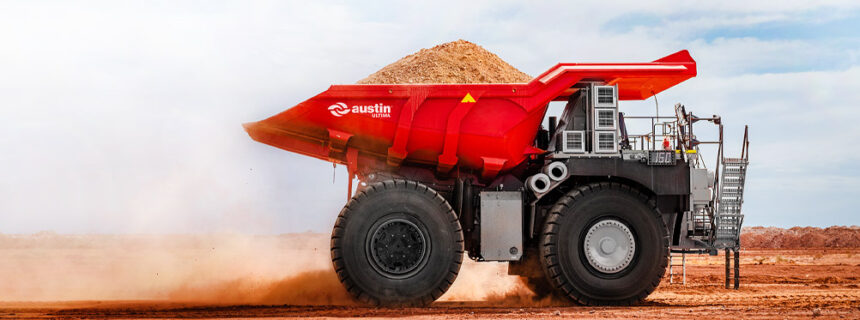
Austin Engineering has spent decades building specialist credibility in a mining-equipment category where performance is measured directly at the pit face. The company describes itself as an ASX-listed engineering firm that designs and manufactures customised dump-truck bodies, buckets, water tanks, tyre handlers and ancillary products for the mining industry. It also says it partners with mining companies, contractors and OEMs to deliver efficiency and safety improvements across open-cut and underground operations.
The company’s physical footprint helps explain why it has become more relevant in recent years. Austin says it operates in Australia, Indonesia, the United States and Chile, with partnerships for final equipment assembly, delivery and parts manufacture that extend its reach further. In mining, proximity matters — not only to shorten delivery lead times, but to keep equipment support close to the customer’s site conditions and production realities.
FY25 was another growth year. Austin’s FY25 results release said group revenue increased 22.2% to $376.7 million, with revenue growth across all four business units. Even though the order book at period end was down year on year to $146.9 million, the company said it retained a strong pipeline and was well positioned to benefit from improved mining conditions globally.
That balance between current growth and future pipeline is important because Austin is not operating in a low-variability market. Demand is linked to mining capex, maintenance cycles, fleet productivity requirements and commodity conditions, all of which can move unevenly by region. What stands out in Austin’s disclosures is that the company has been using this period not only to grow sales, but to deepen product capability and strategic partnerships.
One of the clearest examples of that longer-term capability building is the company’s relationship with Westech. Austin’s own history piece says Westech had been designing and manufacturing customised mining truck bodies for more than 50 years before Austin acquired it in 2007, after previously having a licensee agreement in place. Austin said the acquisition expanded manufacturing capability, market reach, and access to Westech’s deep experience in mining-truck body design.
That acquisition still matters because it shaped Austin’s product identity. The company now presents itself as the world’s largest non-OEM designer and manufacturer of mining dump-truck bodies, and Westech’s legacy clearly sits inside that claim. It is a good example of Austin growing not only by selling more equipment, but by bringing specialist design capability into the group and then scaling it across a broader footprint.
The customer side of the story is just as important. In 2021, Austin announced a five-year mining products and service supply contract with Rio Tinto Services Ltd, covering dump bodies, lightweight ore-truck trays, heavy machinery buckets and related products. While that contract is not brand-new, it remains a useful marker of the sort of mining relationship Austin has been able to secure and hold.
A more recent example comes through the company’s bucket and GET technology push. In September 2025, Austin announced it had completed its first dipper bucket in partnership with Bierwith Forge, integrating Slick Lip system technology. The company said the partnership built on its earlier delivery of a Cat 7495 dipper bucket to a customer in Chile and followed its 2022 acquisition of Mainetec, which had expanded Austin’s bucket offering into builds, rebuilds and related services.
That is an especially good illustration of how Austin is developing. Rather than standing still inside the haul-truck body category, it is broadening into higher-value attachments and technology-enhanced components that can still work with standard OEM rope shovels such as Komatsu (P&H) platforms. In other words, Austin is not just competing on fabrication; it is trying to offer more engineered, site-specific solutions that fit into the fleets miners already operate.
Regional momentum in the Americas is another part of the story. Austin’s FY25 half-year materials said its Chile business had recorded $35 million of new customer orders for FY25 and expected stronger sales into Chile and Peru, particularly to copper miners. Those disclosures matter because they show the company is finding growth not only in mature domestic relationships, but in high-activity mining regions where large-scale fleet performance is critical.
The challenge section for Austin is best framed around mix, timing and working capital rather than demand collapse. Its FY25 results note that higher working capital was tied to inventory build-up for customers in Chile and APAC and to increased trade receivables in APAC and the U.S. That is not a trivial issue, but it is also the kind of operational tension that can accompany growth in a manufacturing business supplying major mining customers across multiple regions.
What makes Austin a strong profile is that its collaborator network is highly tangible. Westech contributes legacy design credibility, Rio Tinto reflects long-term mining-customer trust, Bierwith Forge adds technology enhancement, Mainetec expands the bucket platform, and compatibility with major OEMs like Cat and Komatsu (P&H) keeps the company relevant inside existing mine fleets. Those relationships make the company’s growth story far more concrete than a simple revenue chart could.
Austin today looks like a business with more strategic shape than a conventional metal-fabrication label would suggest. It has IP, a global mining footprint, OEM-compatible products and a growing set of customer and technology relationships that strengthen its role in productivity-focused mining equipment. If it continues to convert those advantages into recurring customer demand, it is well placed to remain a significant specialist in global mining-support manufacturing.