

K&S Corporation: Extending a Long-Established Multi-Modal Freight Network Across Australia and New Zealand
K&S Corporation is the replacement for Silk in the final completed library, and it fits the original brief cleanly as a still-listed regional logistics name. The company describes itself as a provider of transport and logistics solutions across Australia and New Zealand, with operations spanning road, rail, sea forwarding, contract logistics, fuel distribution and specialist regional freight. Its own business pages also make clear that K&S is built around a multi-modal approach rather than pure trucking volume.
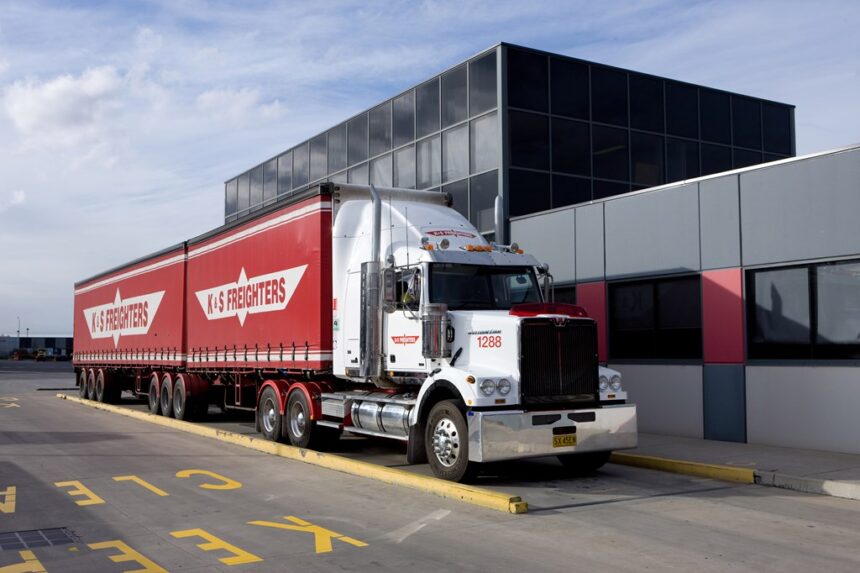
The group’s physical and operational footprint is substantial. K&S Freighters says it maintains one of the largest company-owned and operated fleets in Australia, controls more than 160,000 square metres of warehousing, and operates out of major national locations including Truganina, Enfield, Coopers Plains, Fisherman Islands, Gillman and Kewdale. That gives the business real network depth across both interstate freight and integrated supply-chain work.
FY2025 was mixed but still solid. K&S’s FY2025 results announcement said operating revenue rose 19.3% to A$699.2 million, while underlying profit before tax was A$38.3 million, down 9.0% on the prior year, and underlying profit after tax was A$26.3 million, down 17.2%. In other words, scale continued to build, but profitability remained affected by the realities of a competitive freight and fuel market.
That tension is part of what makes the company interesting. K&S is not a narrow linehaul operator dependent on one single freight niche. It has multiple businesses within the group, including K&S Freighters, DTM Business Logistics and K&S New Zealand, which means earnings are shaped by a broader mix of industrial freight, contract logistics, warehousing and trans-Tasman activity.
The New Zealand business offers one of the clearest examples of the partner layer that now runs through the group. K&S says its New Zealand operation provides distribution, export packing and wharf lodgement across the country, with specific support to Fonterra, Norske Skog and New Zealand Steel. Those are exactly the sort of named industrial relationships that give a logistics profile more substance.
That customer mix also says something important about the company’s operating identity. K&S is not just moving general freight; it is serving industrial and export-oriented customers whose supply chains depend on reliability, handling capability and access to multi-modal transport options. In a market where many logistics groups talk broadly about “solutions,” K&S can point to very concrete service relationships.
The multi-modal model remains a defining strength. K&S Freighters says it provides road, rail and coastal-sea forwarding, export packing, wharf lodgement and integrated supply-chain systems, while other company materials highlight intermodal terminals designed to help customers integrate rail and sea transport more seamlessly. That matters because it broadens K&S’s role from carrier to network designer.
There is also a contract-logistics layer through DTM Business Logistics, which operates facilities in Melbourne, Sydney, Adelaide, Perth and Brisbane. This helps make the group more than just a freight operator, allowing K&S to combine transport, storage and tailored customer logistics work within the same broader network. For a business serving national industrial customers, that integrated structure is a meaningful advantage.
The challenge section is not hard to identify. K&S’s annual-report and results commentary point to competitive and dynamic market conditions, including fuel-related pressure and the need to keep aligning services closely with key customers’ logistics functions. But the group’s response appears consistent: keep broadening service depth, keep using intermodal strength, and keep leveraging long-standing industrial relationships across Australia and New Zealand.
What makes K&S a strong final addition is that the partner ecosystem is visible and material. Fonterra, Norske Skog and New Zealand Steel are important names in their own right, and they help illustrate how K&S wins and keeps freight. Alongside the national K&S Freighters network and DTM contract-logistics capability, they give the company a profile built on long-term industrial usefulness rather than on freight commoditisation alone.