


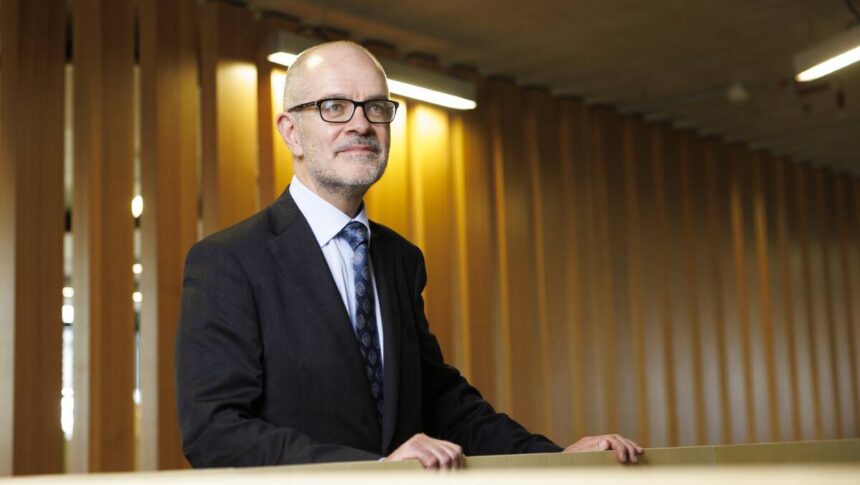
Paul Grimes: Bringing Public-Sector Depth to Australia’s Trade and Investment Agenda
Dr Paul Grimes’ current role is different from many executive profiles because his leadership is not measured by a single company’s share price, acquisition record or product launch. As Chief Executive Officer of the Australian Trade and Investment Commission, better known as Austrade, Grimes leads an institution whose purpose is to help Australian businesses reach new markets, attract investment, and promote Australia as a destination for tourism and study. His appointment was announced by the Australian Government in March 2025.
That makes his current role highly consequential. Austrade sits at the intersection of export growth, investment attraction, tourism, international education and national economic strategy. The government’s appointment announcement explicitly linked the agency’s work to helping businesses grow into new markets, attracting investment including for Future Made in Australia, and promoting Australia internationally. In other words, Grimes has taken the role at a time when trade and investment policy is being pulled into broader questions about supply chains, industrial capability, geopolitical risk and economic resilience.
Because Grimes entered the Austrade role in 2025, his current-role impact should be judged with appropriate care. This is still an early chapter. The significance of his appointment lies less in a completed turnaround and more in the kind of leadership experience he brings to the mandate. Austrade’s corporate plan for 2025–26 to 2028–29 describes a strategy focused on quality trade, investment and policy outcomes aligned with government priorities, delivered in collaboration with Commonwealth, state, territory and industry partners. That is exactly the kind of cross-government operating environment in which Grimes has spent much of his career.
His past experience is unusually broad even by senior public-service standards. Austrade’s own executive profile notes that he has held senior appointments across state, territory and federal government, including Secretary of the NSW Department of Treasury, NSW Coordinator-General for Environment, Energy and Science, Secretary of the Australian Government Department of Sustainability, Environment, Water, Population and Communities, and Secretary of the Australian Government Department of Agriculture.
That breadth is central to his value in the current role. Trade and investment are no longer narrow promotional functions. They require knowledge of industrial policy, climate transition, infrastructure, agriculture, resources, tourism, education, fiscal settings and international markets. Grimes’ career gives him exposure to many of those systems. He is not arriving at Austrade as a career trade promoter only; he is arriving as an economist and public administrator who has worked across several of the policy domains that now shape Australia’s global economic positioning.
One of the most important earlier markers in Grimes’ career was his role in the Australian Government’s response to the global financial crisis. In 2010, he was awarded the Public Service Medal for outstanding public service in the development of that response. That recognition matters because it points to a leader trusted in moments of economic stress, when policy decisions are urgent, technical and politically sensitive.
His Treasury experience is another important part of the story. Before Austrade, Grimes served in senior financial and economic roles including NSW Treasury Secretary, ACT Treasury chief executive, Deputy Secretary in the South Australian Department of Treasury and Finance, and Deputy Secretary of the Budget Group in the Australian Department of Finance. That history gives him a deep grounding in fiscal decision-making, public investment and budget discipline.
That matters because investment attraction is not simply about marketing Australia. It is about understanding what investors need to deploy capital, how government priorities translate into project pipelines, and how policy credibility affects investment decisions. A CEO with Grimes’ background can approach Austrade’s investment mandate with an understanding of how capital, regulation and public finance fit together.
His environmental and energy experience is equally relevant. Grimes has served as NSW Coordinator-General for Environment, Energy and Science, and as Chair of the NSW Net Zero Commission. In an era when trade and investment are increasingly tied to clean energy, critical minerals, decarbonisation and industrial transformation, that experience is not peripheral. It helps position him to lead an agency that must support both traditional exporters and emerging sectors tied to the energy transition.
There is also a governance dimension to Grimes’ profile. Austrade’s executive biography notes his service on several boards, including as Deputy Chair of NSW Treasury Corporation, as a member of Infrastructure NSW, and as Chair of the National Archives of Australia Advisory Council. These roles suggest a leader comfortable operating across institutions rather than inside a single hierarchy.
That is likely to matter at Austrade, where success depends on coordination. The agency must work with exporters, investors, state governments, universities, tourism operators, diplomatic posts and industry bodies. Grimes’ background in cross-agency leadership should help him navigate those relationships. It also gives him credibility with both policymakers and the businesses that need government support to reach international opportunities.
There have been difficult chapters in his career, including his departure from the federal Department of Agriculture in 2015 and the end of his NSW Treasury role after a change of state government in 2023. Those episodes should not be ignored, but they also form part of the reality of senior public leadership. Public-sector executives operate inside political systems where confidence, priorities and institutional direction can change quickly. Grimes’ continued appointment to major roles after those periods suggests that his expertise and public-service standing have remained highly regarded.