

Western Harbour Tunnel — Building Sydney’s Next Harbour Crossing
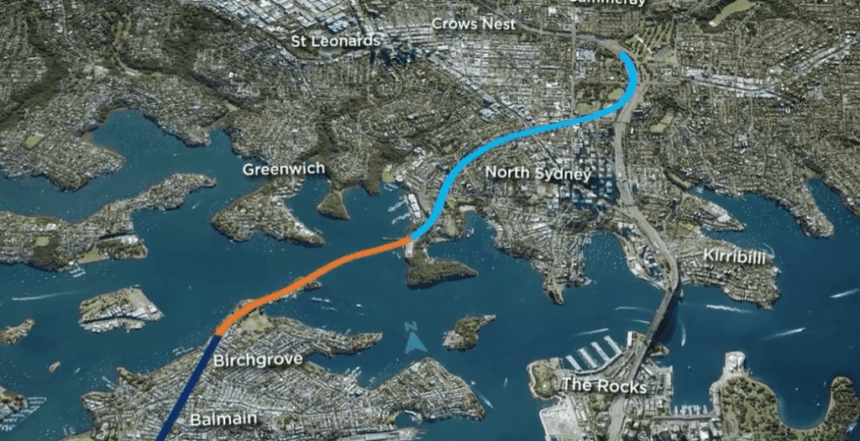
The Western Harbour Tunnel is one of those infrastructure projects whose importance is easiest to understand by looking at the pressure points around it. Sydney’s harbour crossings are among the most recognisable pieces of transport infrastructure in Australia, but they also concentrate an enormous amount of movement through a limited number of corridors. The Sydney Harbour Bridge, Sydney Harbour Tunnel, Anzac Bridge and Western Distributor all carry traffic that is not only local, but metropolitan in scale. Western Harbour Tunnel is being built to create a new western bypass of the Sydney CBD, linking the Warringah Freeway near North Sydney to the WestConnex M4 and M8 at Rozelle Interchange, and easing pressure on the existing harbour crossings and inner-city road network.
That is why the project makes such a compelling Project of the Month. This is not simply another motorway tunnel. It is Sydney’s first new road crossing of the harbour in more than 30 years, a 6.5-kilometre tunnel that will eventually connect the city’s north shore with the inner west and western motorway network. When complete, it is intended to give drivers a more direct route between the north, west and airport precincts, while reducing the need for cross-city traffic to move through the CBD or rely so heavily on existing harbour crossings.
The strategic need is clear. Infrastructure Australia has noted that travel demand across Sydney Harbour is projected to increase, with congestion on the Gore Hill, Warringah Freeway, Sydney Harbour Bridge and Eastern Distributor corridor affecting both bus and private vehicle travel. That matters because harbour crossings are not ordinary roads in Sydney; they are city-shaping chokepoints. When they underperform, the effect is felt across freight routes, public transport reliability, daily commuting and access between major employment centres.
Western Harbour Tunnel’s value therefore lies in redundancy and choice. By creating another harbour crossing west of the existing bridge and tunnel, the project is designed to distribute demand more evenly through the network. It also connects directly into the broader motorway system at Rozelle, which means its usefulness is tied to the larger WestConnex network and the upgraded Warringah Freeway. In transport terms, that makes the project less a standalone asset and more a missing link between major pieces of Sydney’s road infrastructure.
The construction story is equally significant. Western Harbour Tunnel is being delivered in two stages. Stage 1 involved excavation of more than 1.7 kilometres of traffic tunnels from under Emily Street, Rozelle, to Cove Street, Birchgrove. That stage was delivered by the John Holland CPB Contractors joint venture between June 2022 and February 2025. Stage 2 is being delivered by ACCIONA and includes 4.8 kilometres of traffic tunnels from Birchgrove to Cammeray, including the harbour crossing itself, as well as the complete tunnel fit-out.
That staged delivery gives the project a strong sense of visible progress. The southern section has already moved through major excavation, while the northern and harbour sections are now the centre of attention. The latest project scorecard shows Western Harbour Tunnel at 42% complete, with 89% of roadheader tunnelling complete, 34% of tunnel fit-out complete, 2.3 million tonnes of spoil removed from site, 370,000 square metres of concrete used, 5,836 TBM segments produced and 310 box culverts produced. Those numbers are useful because they bring scale to the surface: this is a vast underground construction program, not simply a road alignment on a map.
The most dramatic current chapter is happening beneath Birchgrove. Crews have completed massive twin underground caverns that will serve as launch chambers for the project’s two tunnel boring machines, Barangaroo and Patyegarang. These machines are described as the largest twin TBMs in the southern hemisphere and will excavate the 1.5-kilometre underwater section of the tunnel up to 50 metres below sea level toward Waverton.
The engineering involved is formidable. In January 2026, crews began assembling the two giant TBMs inside 120-metre-long launch chambers beneath Birchgrove, manoeuvring 167 oversized components into place in extremely tight underground conditions. One of the standout lifts involved rotating and positioning a 462-tonne, 15.7-metre-wide cutterhead, with as little as 1.5 metres of clearance between machinery and the chamber walls in parts of the assembly environment.
Those details matter because they show the hidden discipline behind a project like Western Harbour Tunnel. The public will eventually experience the tunnel as a smoother drive, but the construction industry sees something else: underground logistics, heavy lifting, tunnel support, segment production, spoil management, ventilation planning, safety systems, roadheader excavation, TBM assembly and eventual systems commissioning. Every metre of progress depends on sequencing, survey control, geotechnical understanding and the ability to keep work moving in constrained urban conditions.
The harbour section gives the project its strongest engineering identity. Tunnelling under Sydney Harbour is not just technically challenging; it is symbolically powerful. Sydney’s earlier harbour crossings became landmarks of their eras. Western Harbour Tunnel is less visible by design, but it will still become part of that same lineage. It will not announce itself on the skyline the way the Harbour Bridge does, but it will reshape how traffic moves beneath the city.
The Warringah Freeway Upgrade is also central to the story. The tunnel’s usefulness depends heavily on how well traffic can enter and exit the system on the north side of the harbour. Transport for NSW describes the broader project as improving capacity and providing new direct routes and reliability on both sides of the harbour, including better bus routes between the Inner West, Sydney and North Sydney and connections with Sydney Metro and Sydney Trains.
That integration is important because major road tunnels can fail to deliver their full benefit if surface connections become bottlenecks. The Warringah Freeway Upgrade is therefore not a secondary package; it is part of the operating logic of the entire project. It is intended to simplify one of Sydney’s most complex road corridors, improve safety and reliability, and prepare the northern network for a new harbour crossing.
Western Harbour Tunnel also has a technology story. The NSW Government has announced that the tunnel will be Australia’s first tag-free toll road when it opens to traffic in late 2028. Instead of relying on a physical e-tag, the tolling system will use video-based licence plate matching linked to toll accounts. The government says the system is intended to reduce tolling infrastructure complexity, avoid plastic and battery waste from tags, and maintain performance without the familiar in-car “beep.”
That may sound like a small operational detail, but it points to the way modern infrastructure is changing. Major tunnels are no longer just civil assets; they are digital operating environments. Tolling, incident detection, ventilation, lighting, safety systems, communications and traffic management all contribute to how the asset performs. The decision to make Western Harbour Tunnel tag-free gives the project a distinctive place in Australia’s toll-road evolution, not just Sydney’s harbour-crossing history.
The project’s workforce and sustainability details also add to its significance. The latest scorecard records 3.92 million total workforce hours, 89% local employment, 689 women who have worked on the project, 187 Aboriginal workers, 50,000 training hours and 88 apprentices or trainees. It also reports that 94% of construction waste has been diverted from landfill, 70% of water recycled, 100% renewable energy used on the project, and 100% of excavated spoil reused or recycled.
For the construction sector, those numbers are not decorative. They show how large infrastructure projects are increasingly being judged not only by traffic outcomes, but by their contribution to skills, participation, local employment, procurement, waste reduction and resource recovery. Western Harbour Tunnel is a transport project, but it is also a major workforce and industry-capacity project.
A balanced feature should also recognise that major projects built through dense urban areas bring real disruption. Transport for NSW has developed noise management and noise insulation measures for the Western Harbour Tunnel and Warringah Freeway Upgrade, acknowledging that construction and operational noise can affect nearby communities. The project’s own noise materials say the Environmental Impact Statement predicted an overall reduction in operational noise impacts for more than 60% of properties near surface roads once the project is complete, but the need for mitigation during construction remains part of the project reality.
There is also public sensitivity around tolling. The Western Harbour Tunnel will open as a tolled road, and broader changes to Sydney tolling have already generated political debate, particularly around two-way tolling on existing harbour crossings and the government’s plans for toll reform. That does not change the engineering case for the project, but it does underline an important point: infrastructure is never only technical. It sits inside public arguments about fairness, cost of living, congestion, mode choice and who benefits from new capacity.