
Economic Development Queensland: Unlocking Homes, Growth and Major Precincts at State Scale
Economic Development Queensland has been sharpening its public identity around one core challenge: helping Queensland grow faster and more coherently in an environment defined by housing need and rapid population expansion. Its homepage describes EDQ as the Queensland Government’s land-use planning and development agency, working to remove barriers for industry, accelerate homes and create jobs. The agency’s broader strategic language — “a Queensland planned and built for growth” — signals that it sees itself not simply as a regulator, but as an active growth enabler with a delivery mandate.
That delivery role is reinforced in the 2024–25 annual report and activity snapshot. EDQ said it had unlocked land to deliver more homes while helping businesses grow, and the annual report also described the Economic Development Board as dedicated to ensuring EDQ becomes a one-stop shop to partner with government in releasing land and unlocking housing delivery. That is an important phrase because it reflects a genuine service-positioning shift: EDQ is trying to become easier for industry and government to work with, not just more authoritative.
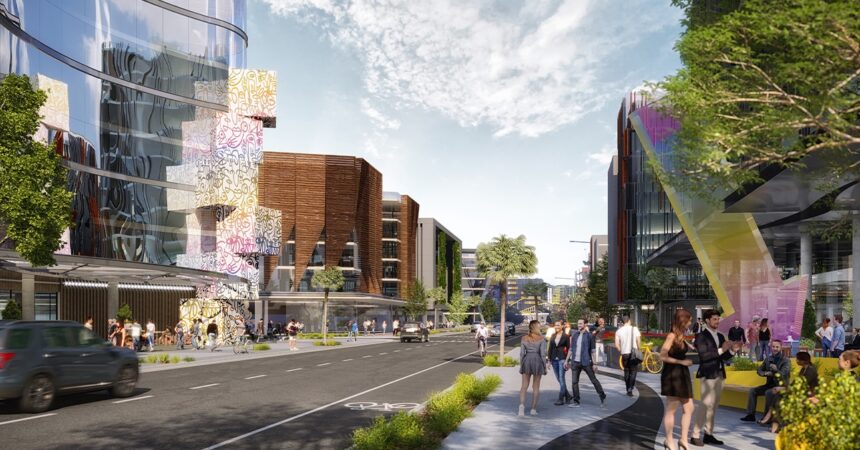
The clearest example of the agency’s operating model is Northshore Hamilton. EDQ describes Northshore as a 304-hectare riverfront urban-renewal area close to the Brisbane CBD, airport and trade-coast precinct, with more than three kilometres of river frontage. It also says that, as landowner, master developer and planning authority, EDQ is facilitating roads, public realm and premium development-ready land over the next 15 to 20 years. That combination of roles is critical: EDQ is not only approving development there, it is actively shaping the underlying urban framework.
That same logic extends across the Priority Development Area (PDA) model more broadly. EDQ’s PDA material says the program is being expanded in response to Queensland’s housing shortfall, with the intention of accelerating development through a structured partnership model involving government and industry. The fact that EDQ uses this model at scale is part of what gives it weight: the agency has mechanisms that can influence not just one precinct, but the pace and structure of housing and mixed-use development across multiple parts of the state.
The agency’s recent funding and pipeline messaging also strengthens the profile. EDQ’s homepage says the 2025–26 investment pipeline includes $174.1 million for delivery of new housing supply, $84.6 million for enabling infrastructure linked to housing, and $68.1 million for Northshore Hamilton urban renewal, alongside $830 million in private-sector investment generated and more than 1,700 jobs created or supported. Those figures matter because they make the agency’s role more concrete: EDQ is tying strategic planning to real capital flows, real sites and measurable delivery outcomes.
The partner ecosystem around that work is becoming more explicit too. EDQ’s “Partner with us” messaging says it works with industry, local government and communities to unlock homes, prosperity and liveable places at scale and pace. Its EDQ Industry Forum in June 2025 brought together more than 130 representatives from government, industry and local councils to engage with the agency’s strategic direction, while a later October 2025 forum again highlighted collaboration on housing, land release and precinct opportunities. Those are useful signals that EDQ is trying to operate not just as a policy instrument, but as a convening platform for growth delivery.
Regional engagement is part of that same story. EDQ’s own reporting says executive leaders met with local councils, industry leaders and community stakeholders in places such as Cairns, Townsville and Rockhampton to explore ways to accelerate housing supply and regional growth. That matters because it shows the agency’s work is not confined to South East Queensland’s largest urban-renewal sites. It is also attempting to function as a statewide partner in unlocking land, infrastructure and development pathways where growth pressures are rising beyond Brisbane itself.
The challenge EDQ is trying to address is obvious in its own public language: fragmented land activation, housing shortages, development friction and the need for faster, more coordinated delivery. But the agency’s current reporting suggests it is responding with a clearer mandate, more visible funding pathways and a stronger customer-and-partnership focus. That makes EDQ one of the more interesting state agencies in your expanded set. It is not just writing policy. It is trying to act as a bridge between land, infrastructure, housing and economic opportunity at a scale few public bodies can manage.