


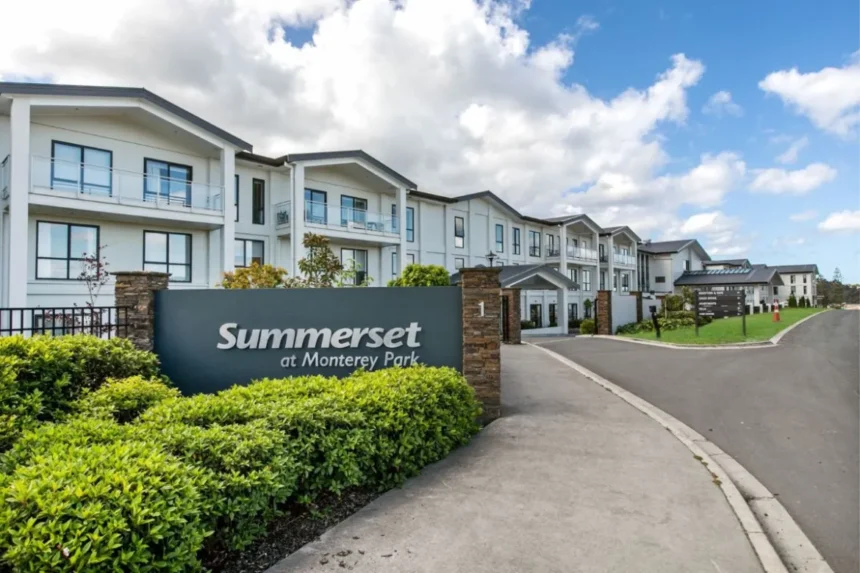
Summerset: Growing a Trans-Tasman Retirement-Village Platform Through Continuum-of-Care Scale, Greenfield Expansion and Australian Entry
Summerset is not Australian-founded, but it is publicly listed on both the NZX and ASX, and it is one of the clearest listed operators running a large-scale retirement-village platform with active expansion into Australia. Its investor-centre materials say the company was founded in 1997, listed on the NZX in 2011 and on the ASX in 2013, and has grown into one of New Zealand’s largest and most respected operators in the retirement-village and aged-care sector. What makes Summerset particularly relevant here is that it now combines deep New Zealand scale with a visible Australian rollout, which gives the business a broader growth profile than a purely domestic operator.
The current platform is substantial. Summerset’s investor-centre snapshot says that, as at the end of 2025, the group had 9,500-plus residents, 3,200-plus staff, 44 villages completed or under development, 7,198 retirement units in portfolio, 1,475 care units in portfolio, and 10 greenfield sites still to be developed. It also recorded 1,560 sales of occupation rights in 2025. Those figures matter because they show a business operating at real scale across multiple parts of the retirement continuum — independent living, assisted living and care — rather than relying on one narrower housing format.
The financial picture is equally strong. Summerset’s investor-centre highlights reported FY25 net profit after tax of $259.7 million, underlying profit of $234.2 million, total assets of $9.2 billion and operating cash flow of $548.2 million. These are not the numbers of a small experiment in retirement living; they belong to a business with real asset depth and operating maturity. For your editorial purposes, that means Summerset can be covered not just as a village operator, but as a sophisticated later-living development and care platform with long-duration relevance.
What makes the company especially interesting now is the way it is using that mature New Zealand base to support Australian growth. Summerset’s investor-centre overview says it has another seven quality land sites in New Zealand and three in Australia, while the company’s Australian careers and consumer pages say it welcomed its first Australian residents in 2024 at Summerset Cranbourne North in Victoria. That is a pivotal milestone because it shifts the Australian story from site assembly and planning into actual resident occupancy, which always makes a platform expansion feel more real.
The Australian pipeline is already becoming visible beyond that first village. Summerset’s Australian village pages currently list Cranbourne North as operating, with Chirnside Park and Torquay under development and additional proposed sites such as Craigieburn, Drysdale, Mernda and Oakleigh South in Victoria. The company’s Australian “Find a Village” pages make clear that each site is intended to offer a familiar Summerset model: independent living, assisted living and an on-site care home within a resort-style community setting. That consistency matters because it suggests the Australian rollout is not being improvised; it is being transplanted from a well-developed operating template that has already been tested across dozens of villages in New Zealand.
The “continuum of care” is central to that template. Summerset’s Australian and New Zealand consumer pages both emphasise the ability for residents to access different levels of support over time, from independent living through to assisted living and residential aged care, subject to availability and eligibility. This is not just a marketing phrase; it is one of the main reasons the Summerset model looks stronger than a simpler over-70s housing product. It creates a more durable village proposition for residents and families while also improving the economic depth of each development.
The physical product is also deliberately experience-led. Summerset’s Australian pages say villages are designed specifically for people aged 70 and over, with a choice of villas, townhouses, assisted-living apartments and care suites, supported by resort-style facilities and a calendar of activities. The facilities pages list elements such as swimming pools, workshops, libraries, cafés, communal gardens and activity spaces as typical village features. Those details are important because they show Summerset’s growth is not just about selling units; it is about replicating a lifestyle-and-care environment that has been central to the brand in New Zealand.
The challenge, of course, is that retirement-village development is capital-intensive and long cycle, especially when combined with care infrastructure and trans-Tasman expansion. Summerset’s public disclosures do not hide that the company is still building out a large greenfield pipeline, and the Australian rollout remains at an early stage compared with the New Zealand base. But this is also where the New Zealand scale matters: the company enters Australia not as a start-up, but as an operator with decades of delivery experience, thousands of residents, strong cash flow and a fully developed resident-care model. That makes the Australian expansion look more measured and credible than it would for a less mature entrant.
The collaborator angle is more implicit here than in a contractor or infrastructure profile, but it is still present and meaningful. Summerset’s model is built through relationships with residents, families, care teams and regional planning systems, while the Australian rollout is clearly being shaped through village-by-village land and approvals work in Victoria. The Australian site network itself — Cranbourne North, Chirnside Park, Torquay, Craigieburn and other proposed locations — is evidence of a company working systematically through local growth corridors rather than taking a one-site gamble. In a later-living context, those development and operating relationships are as important as any one corporate partner announcement.
What makes Summerset such a valuable addition to this segment is that it gives you a different scale and style of listed later-living story. Eureka shows what an affordable seniors-rental roll-up can look like in Australia. Summerset shows what a large, highly systemised retirement-village and care platform looks like when it starts extending across the Tasman. For your broader editorial library, that contrast is useful. Summerset is not merely running villages; it is building a long-horizon continuum-of-care platform, and its first Australian foothold suggests that the next stage of growth will be about exporting a proven model into a new but highly relevant market.