

Finbar: Staying Focused in High-Density Living While Using Long-Term Partnerships to Keep Delivering
Finbar has built its identity around a very specific part of the residential market and has remained unusually consistent in that focus. The company says its core business lies in the development of medium- to high-density residential apartments and ancillary commercial property, and its investor materials describe it as Western Australia’s largest and most trusted apartment developer with more than 30 years of experience, 79 landmark developments and over 7,400 apartments delivered with a gross end value of about $4.5 billion.
That clarity of positioning is one of the company’s strengths. Finbar is not trying to be all things across the broader property landscape; it has stayed close to the Perth apartment market, where long-standing local knowledge, repeat consultant relationships and builder continuity appear to have become genuine competitive advantages rather than simple habits. In a development environment that has become more constrained and selective, that kind of narrow-but-deep model can be powerful.
Its FY25 materials suggest that discipline is paying off. Finbar described FY25 as a robust result, finished the year with $36.4 million in cash, and said net debt had fallen by $360 million to $56.7 million. The company also emphasised that maintaining deep stakeholder engagement — especially with relationship builder Hanssen Pty Ltd and a core group of consultants, contractors and suppliers — had created a key competitive advantage in a market where broader construction-capacity constraints continue to act as a barrier to new entrants.
That builder relationship is probably the clearest operational thread running through the current Finbar story. In the company’s FY25 overview, Hanssen is singled out by name, which is unusual enough to matter. It suggests the company sees execution reliability and aligned project-delivery capability as central to how it has kept projects moving while others in the apartment market have faced more acute delivery bottlenecks.
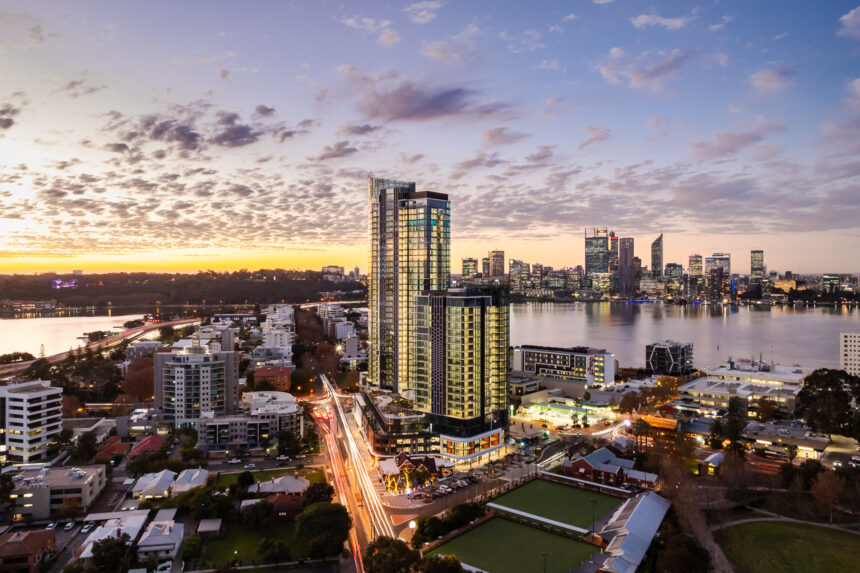
The Civic Heart project in South Perth is the best-known recent example of that model at work. Finbar announced the project’s completion in July 2024, describing it as Perth’s tallest residential building and its most complex and ambitious project to date. The development includes two towers of 37 and 20 levels, 308 apartments, heritage-building repurposing, a redesigned Mends Street and a ground-floor commercial precinct.
The partner and stakeholder picture around Civic Heart is especially strong. Finbar explicitly thanked Hanssen, SS Chang Architects, consultants and contractors on completion, and its earlier topping-out event included representatives from the City of South Perth, Commonwealth Bank, SS Chang and Hanssen. Those names help make the project feel less like a standalone tower and more like a large, multi-stakeholder urban-renewal effort with financing, civic, design and construction inputs all working together.
That same delivery network appears again at The Point in the Springs Precinct. Finbar said the project was created through close collaboration with long-term partners Hanssen Construction and Chang Architects, and later announced that the development had reached completion as an entry statement for the broader precinct. For a company like Finbar, repeated use of the same builder and architect pairing is not just a comfort-zone decision — it looks more like a way of protecting execution quality and compressing risk in a market that still has limited margin for mistakes.
The significance of those recurring relationships is hard to overstate. Apartment development in Western Australia has not been an easy environment in recent years, and Finbar’s own materials acknowledge ongoing construction-capacity constraints and subdued competitor activity. The fact that Finbar frames those market conditions as something it can navigate through deeper stakeholder engagement says a lot about how the company sees itself: less as a speculative developer, and more as a disciplined operator with a repeatable project ecosystem.
There is also a governance and succession story underway. Finbar’s current leadership page says John Chan transitioned to Non-Executive Chair in 2026 after playing a pivotal role in shaping the company’s strategic direction and growth for more than three decades. It also says Ronald Chan became Chief Executive Officer in June 2025 after more than 22 years with the company, while Melissa Chan assumed the role of Chief Operating Officer in 2025.
That continuity matters because it reinforces the sense of a business that has grown through internal depth rather than disruptive reinvention. Ronald Chan’s long tenure, in particular, suggests that Finbar’s next chapter is likely to remain grounded in the same core operating logic that built the company’s track record, even as leadership responsibilities shift. For investors, buyers and partners alike, that sort of continuity can be reassuring in a development market where execution is everything.
The challenge section for Finbar is therefore less about survival and more about maintaining edge. Construction constraints remain real, delivery risk remains high, and the apartment sector is still demanding. But Finbar’s public disclosures suggest the company is facing that environment from a position of relative strength: a healthier balance sheet, a long record of profitability, and a tightly held network of builder, architect and consultant relationships that continue to deliver.
That is what makes Finbar a compelling profile. The company does not read like an operator trying to reinvent the rules of development. It reads like one that has spent decades learning how to execute high-density residential projects well in one market, and then doubling down on the relationships that make that possible. In a property cycle that increasingly rewards competence and trust, that is a strong place to be.