
Elixir Energy: Moving the Taroom Trough Story from Appraisal Toward Development
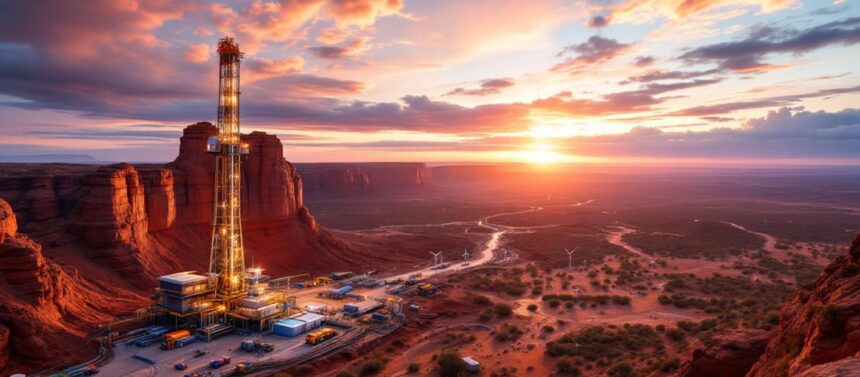
Elixir Energy has spent the last few years building a gas position in the Taroom Trough, and the company’s public materials now present that portfolio much more as a development platform than a pure exploration punt. Its investor overview says Elixir is focused on maximising shareholder return through two major assets, the Grandis Gas Project and the Diona Gas Project, while the company homepage says total contingent resources in the Taroom have now reached 3 TCFE.
Grandis remains the centrepiece. Elixir says the project comprises 100% interests in ATP 2044 and ATP 2077A/B, covers more than 1,000 square kilometres, and sits close to the Wallumbilla gas hub, which connects to both domestic and international markets. That proximity to established transmission infrastructure is a recurring strength in the company’s own description of the asset.
What makes the story stronger today is the way Grandis has expanded beyond the original acreage. In February 2025, Elixir executed two farm-in agreements with a wholly owned subsidiary of Santos over ATP 2056 and ATP 2057, earning the right to a 50% working interest in each permit by funding exploration work. The company says those licences are strategically adjacent to Grandis and contain extensions of the same basin-centred gas play that Elixir has already been proving up.
That Santos relationship is one of the most important collaborator markers in the company’s profile. It shows Elixir’s Taroom thesis being taken seriously enough to support a formal farm-in structure with a major Australian energy company, while still allowing Elixir to operate the early work programs. In a basin where scale and continuity matter, that kind of partner alignment can be more valuable than a simple acreage map.
The 2026 operational flow has added more substance. Elixir’s announcements page shows a fast sequence of milestones: Lorelle-3 intersected multiple Permian reservoirs in February, the company then reported outstanding results at Lorelle-3, followed by a Lorelle-3H update in March stating that more than 1,000 metres of net gas pay had been recorded. It also announced that a Taroom Trough pipeline feasibility study had commenced in April 2026.
That sequence matters because it starts to shift the company from “interesting gas acreage” toward “commercial system planning.” The move from reservoir intersection and horizontal-well results into pipeline feasibility is exactly the kind of operational progression that makes a development story feel more real. It is still early, but the company’s own recent disclosures show a business trying to line up subsurface results with midstream thinking.
The portfolio is also broader than Grandis alone. Elixir’s company overview says the Diona project, in ATP 2077C, is part of the current focus, and that 51% of Diona has been assigned to XState Resources under a farmout arrangement. That adds another layer to the partner ecosystem and reinforces the point that Elixir is not trying to carry every block at 100% on its own balance sheet.
There is also a technical-validation layer worth noting. Elixir’s contingent-resource page cites assessments by ERCE across parts of the Taroom position, while the company’s materials repeatedly distinguish between tight sandstones and fractured thermally mature coals as the main targets. That sort of formal resource work is important in a basin where the geological idea is large, but commercial pathways still need to be progressively demonstrated.
The challenge section, naturally, is about execution. Elixir remains in the stage where drilling results, resource certification, partner alignment and commercial infrastructure planning all need to keep moving together. But the company’s public positioning is much stronger than it was when Grandis first appeared as a basin concept: it now has multi-block scale, a Santos farm-in, a Diona/XState structure, large contingent resources and a visible shift toward development studies.
That is what makes Elixir a strong feature. The company is no longer telling a one-dimensional exploration story. It is telling a basin-building story, and its collaborators — Santos, XState Resources and ERCE — are part of what makes that narrative increasingly credible. If it keeps turning appraisal success into commercial planning, Elixir could become one of the more consequential gas-development stories on the east coast.