

Strike Energy: Building an Integrated Western Australian Energy Business Around Gas, Power and Low-Carbon Industry
Strike Energy has become much easier to understand over the last few years. Its homepage now describes the company as a proudly Western Australian business building an integrated, low-carbon energy platform based on Perth Basin gas and new-energy resources, with the stated aim of supplying sustainable, low-cost and reliable energy to support the State’s transition away from coal-fired generation. That is a bigger ambition than the exploration-led version of Strike that first came to market.
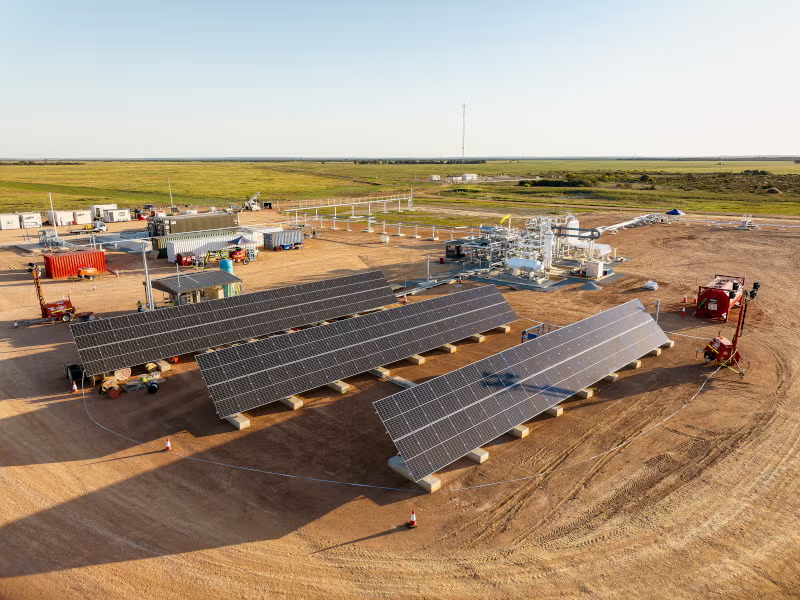
The producing foundation of that strategy is Walyering. Strike says Walyering transformed the company from explorer to producer, moving from discovery to sanction in just nine months, and that the facility was designed to run on 100% solar and battery power with very low Scope 1 emissions for domestic gas in Western Australia. That gives the company a tangible operating asset as well as a cleaner-energy narrative.
The next major leg is South Erregulla. Strike’s project page says the field sits within L24 and EP503, is 100% owned and operated by Strike, and lies adjacent to the company’s 50% owned West Erregulla acreage. The company has also approved an 85MW South Erregulla peaking gas power station, designed to firm renewable generation and connect into the South West Interconnected System.
That is an important shift because it shows Strike moving up the value chain. It is not just producing gas; it is developing gas-backed power infrastructure that can help stabilise a grid undergoing a renewables transition. In Western Australia, where firming capacity is strategically valuable, that makes the South Erregulla project much more than a standard upstream development.
The most ambitious part of the portfolio remains Project Haber. Strike’s historical and current project materials show Haber evolving from a low-carbon urea concept into a broader industrial platform that has at times incorporated green hydrogen and carbon-sink pathways. The company said Technip Energies completed the project’s Pre-FEED work, and later disclosures said the project had also been granted Major Project Status.
That partner detail matters because it gives Haber more industrial credibility. Technip Energies is a serious engineering counterparty, and Strike also commissioned ACIL Allen for economic-impact work that the company said showed substantial potential benefits for the Mid-West, Western Australia and the national economy. While those studies do not eliminate development risk, they do show Strike trying to ground the project in more than internal enthusiasm.
There has also been a meaningful corporate consolidation layer. Strike’s acquisition of Talon Energy became effective in late 2023, and the company now hosts a dedicated page for former Talon shareholders. That deal matters because Talon had exposure to assets that fit closely with Strike’s broader Perth Basin and development strategy, helping simplify ownership and expand the company’s integrated energy positioning.
The challenge section is straightforward: Strike is trying to do several difficult things at once. It is producing gas, developing a peaking power station, advancing a major industrial precinct concept, and trying to balance near-term returns with a lower-carbon long-term identity. But the company’s project pages suggest these pieces are now fitting together more coherently than before, with Walyering, South Erregulla and Haber each serving different parts of the same WA energy story.
What makes Strike a particularly strong profile is the visibility of its collaborators and operating architecture. Technip Energies, ACIL Allen, Talon Energy, and the wider South Erregulla / Walyering project set all reinforce the idea that Strike is no longer just a gas explorer. It is trying to become a broader energy-and-industrial company, and the pieces of that strategy are now visible in the field, not just on presentation slides.