

North East Link — Building Melbourne’s Missing Connection
North East Link is one of those infrastructure projects that is best understood not as a single road, tunnel or interchange, but as a long-delayed piece of metropolitan logic finally being put into place. For decades, Melbourne’s freeway network has had a conspicuous gap in the north east: the missing connection between the M80 Ring Road and the Eastern Freeway. North East Link is designed to close that gap, giving freight, commuters and cross-city traffic a more direct route while taking pressure off the suburban roads that have long carried traffic they were never really designed to handle. Victoria’s Big Build describes the project as the biggest ever investment in Melbourne’s north east, with the 6.5-kilometre tunnels from Watsonia to Bulleen intended to take 15,000 trucks off local roads each day and reduce travel times by up to 35 minutes.
That is the clean public promise of the project: less time lost in traffic, fewer trucks on local streets, and a more complete orbital road network for Melbourne. But the reason North East Link makes such a strong Project of the Month is that its construction story is just as significant as its transport story. This is not a modest road widening exercise. It is a multi-package program involving twin three-lane tunnels, major upgrades to the Eastern Freeway and M80 Ring Road, new interchanges, new walking and cycling connections, parkland improvements, and one of the most complex urban tunnelling efforts currently underway in Australia. The Department of Treasury and Finance describes North East Link as the largest investment in a road project in Victoria’s history and says the link is expected to carry up to 135,000 vehicles daily once complete.
At the centre of the project are the tunnels themselves. Running between Watsonia and Bulleen, the North East Link tunnels are being built up to 45 metres underground, passing traffic beneath local suburbs rather than pushing more surface road infrastructure through established communities. That underground alignment is central to the project’s design philosophy: it is not only about building a road, but about limiting the physical disruption of that road on the communities above it. Victoria’s Big Build says the tunnels are being built to preserve more parkland and recreational areas from Borlase Reserve and Banyule Creek in Yallambie through to the Yarra River precinct in Bulleen.
The most visible symbols of that tunnelling effort are Zelda and Gillian, the two tunnel boring machines working their way from Watsonia to Bulleen. Zelda began tunnelling in August 2024 on the northbound tunnel, followed shortly after by Gillian in September 2024 on the southbound tunnel. Each TBM operates around the clock with crews of operators, electricians, mechanics, ring builders and tunnel engineers. The latest Big Build tracker shows just how far the machines have advanced: Zelda has excavated 5,064 metres of a 5,098-metre drive, while Gillian has excavated 4,449 metres of a 4,948-metre drive.
Those figures make the project feel very much alive. North East Link is no longer just a plan, procurement model or artist impression. It is now a tunnelling operation nearing the end of one of its most technically important phases. In October 2025, the Victorian Government said the two 15.6-metre-diameter, 90-metre-long TBMs were well over the halfway point, having travelled more than three kilometres each and installed more than 25,000 pre-cast concrete tunnel segments made in Benalla. By that stage, more than 8,000 people were working across North East Link, with the project expected to create more than 12,000 jobs in total and 10% of work hours being delivered by apprentices, trainees and cadets.
That workforce story is important because large infrastructure projects are often discussed only in terms of cost and congestion relief. North East Link is also a major industry-capacity project. It is training workers, engaging specialist tunnelling expertise, supporting local manufacturing through concrete segment production, and creating opportunities across civil construction, engineering, traffic management, systems integration, road operations and long-term maintenance. For the construction sector, it is a live demonstration of the kind of integrated delivery capability required to build major urban infrastructure in a dense, complex city environment.
The delivery structure is also notable. The $11.1 billion Primary Package was procured as an availability-based public-private partnership, with financial close reached in October 2021. The Spark consortium — including WeBuild, GS Engineering and Construction, CPB Contractors, China Construction Oceania, Ventia, Capella Capital, John Laing Investments, DIF and Pacific Partnerships — was awarded the main tunnel package. The primary package includes the twin three-lane tunnels, interchanges at Lower Plenty Road and Manningham Road, upgrades around Bulleen Road, new and upgraded green land bridges, and walking and cycling infrastructure forming part of the new North East Trail network.
The PPP model matters because North East Link is not just being built for opening day. The tunnels will also need to be operated, maintained and renewed over a long asset life. The project therefore brings together design, construction, financing, operations, maintenance and lifecycle management in a way that reflects the modern reality of infrastructure delivery. Major roads are no longer simply concrete and asphalt assets; they are technology-enabled systems with ventilation, safety, tolling, communications, monitoring, incident response and managed motorway interfaces.
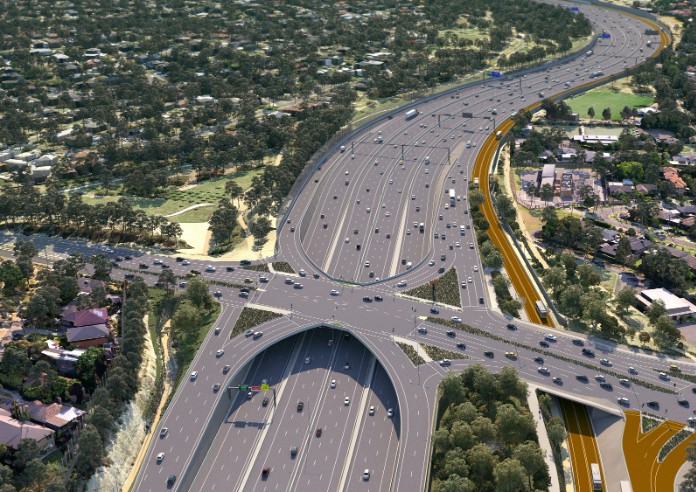
That systems element is especially visible in the Eastern Freeway upgrades. As part of the broader program, the Eastern Freeway is being upgraded with new express lanes, managed motorway technology and Melbourne’s first dedicated busway. That last element is easy to overlook, but it is important. North East Link is a road project, but it is also intended to improve bus movement and multimodal connectivity across the corridor. The opening of a section of the Bulleen Road Interchange in July 2025 marked the first permanent road section to open as part of the project, while also allowing traffic to keep moving as crews continue building the tunnel entrance and major interchange that will eventually connect the Eastern Freeway to the 6.5-kilometre tunnels.
The Bulleen Road Interchange milestone also illustrates the scale of the physical works. To build the new 270-metre section of Bulleen Road, crews installed more than 100 of the largest Super T beams ever built in Victoria, each up to 43 metres long and weighing up to 126 tonnes. Details like that help bring the project out of abstraction. This is the kind of infrastructure where every milestone depends on heavy lifts, night works, traffic staging, community disruption planning, supply chain coordination and careful sequencing between temporary and permanent works.
The project’s community-facing design has also evolved in response to feedback. Victoria’s Big Build says the tunnel design was lengthened to 6.5 kilometres, with simpler interchanges, five MCGs of parkland along Banyule Creek at Borlase Reserve, a new two-kilometre tree-lined Greensborough Road boulevard, a two-hectare Yarra Link green bridge over Bulleen Road, and three new wetlands along the Yarra River and Koonung Creek in Bulleen and Balwyn North.
That part of the project is worth emphasising because major road projects often face criticism for dividing communities or prioritising cars at the expense of local amenity. North East Link is still a road project, and a major one, but its design response shows how expectations have changed. The project has had to include parkland, wetlands, green bridges, tree canopy, shared paths and better active transport connections as part of its core public value proposition. In total, the broader program is delivering more than 34 kilometres of new and upgraded walking and cycling paths, including links to Yarra River trails, the Koonung Creek Trail, local parklands, schools, community clubs and station precincts.
A balanced profile should also acknowledge that North East Link has not been without scrutiny. Like many large infrastructure projects in Australia, it has faced public attention over cost escalation, construction disruption and tunnelling complexity. In January 2026, tunnelling was paused after a sinkhole opened at AJ Burkitt Oval in Heidelberg. ABC News later reported that investigations found a planned test during excavation had caused the ground to cave in, and that authorities said tunnelling would resume with the incident not expected to add cost or delay to the project.
That episode is a reminder that infrastructure of this scale is never just a technical exercise. It is built in public, under communities, beside live roads, and under intense scrutiny. The real test of a major project is not whether it avoids every challenge, but whether it responds transparently, strengthens controls and continues safely. In that sense, North East Link’s construction phase is also a case study in risk management, community trust and engineering discipline.
When complete, North East Link is planned to open in 2028, bringing together the tunnels, M80 Ring Road Completion and Eastern Freeway Upgrades into a single operating corridor. The project will be tolled, with the State retaining toll revenues initially through a State-owned tolling company, while the Eastern Freeway and M80 Ring Road will remain toll free.