

Lindsay Australia: Extending a Paddock-to-Plate Logistics Model Through Acquisitions, Rural Reach and Cold-Chain Scale
Lindsay Australia has built its identity around a relatively simple but valuable idea: being useful across more of the agricultural supply chain than a typical transport operator. The company says it is an ASX-listed integrated transport, logistics and rural supply group with a specific focus on food processing, food service, fresh produce and horticulture. On its main site, it describes itself as working in partnership with Australian farmers at all levels of the supply chain.
That “paddock to plate” framing is not just branding. Lindsay’s operating structure spans Lindsay Transport, Lindsay Rural, Lindsay Fresh Logistics, and the acquired businesses WB Hunter and SRT Logistics, giving it exposure to freight, warehousing, produce-market handling, rural merchandising and cold-chain distribution. The breadth of that model is one of the main reasons the company stands out in the listed logistics space.
FY2025 showed both the scale and the complexity of that model. In its FY2025 annual report, Lindsay said group revenue rose 5.6% to $849.8 million, while underlying EBITDA fell 11.7% to $81.4 million and underlying net profit before tax fell 27.9% to $31.9 million. Management linked the softer earnings result to margin pressure in transport and difficult seasonal and weather conditions in key horticultural regions.
Those figures matter because they tell a more realistic story than a simple growth headline would. Lindsay is not a frictionless logistics growth machine; it is an operationally intensive business exposed to fuel, labour, seasonality and produce-market conditions. But the same disclosures also show a company still investing in its network, still growing revenue, and still broadening its national capability through acquisitions and facility upgrades.
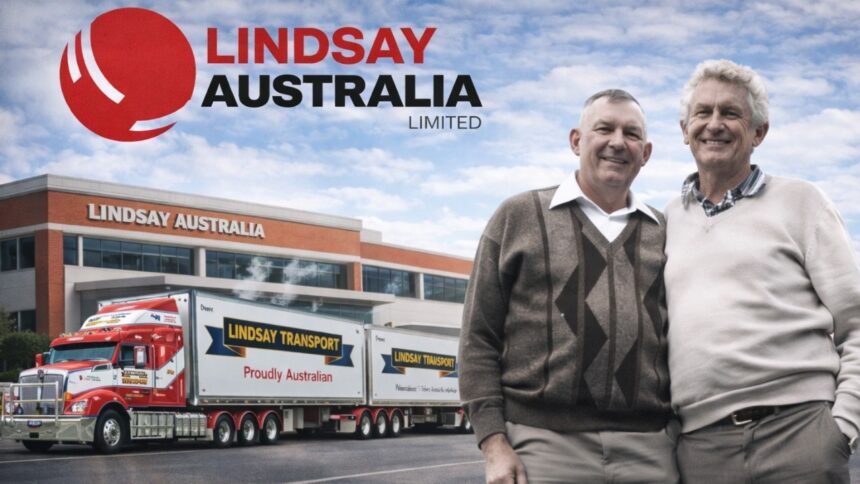
The transport business remains the core engine. Lindsay says its transport arm has been operating since 1953 and has become one of Australia’s largest refrigerated transport companies, delivering more than 2 million tonnes of freight to more than 3,200 customers. In FY2025, transport revenue rose to $574.0 million, supported by growth in freight services and network optimisation across the east coast.
But the broader model becomes more interesting when the partner and acquisition layer is added. In July 2023, Lindsay acquired WB Hunter, a long-established rural merchandising business with an eight-store footprint across northern Victoria and southern New South Wales. The company says that acquisition aligned with Lindsay Rural’s ambitions and strengthened its reach into agricultural-supply markets where agronomy, fencing, nutrition and trade products all matter.
That acquisition is more than a bolt-on. It shows Lindsay pushing further upstream into relationships with farmers rather than focusing only on downstream freight. The annual report says a bolt-on acquisition, Nagambie Equine Rural, was also added to WB Hunter in FY2025, reinforcing the sense that Lindsay is trying to build a broader rural-services platform rather than just a bigger trucking network.
The same logic applies on the logistics side. SRT Logistics became a wholly owned subsidiary of Lindsay in May 2025, with the company describing the deal as creating the country’s largest refrigerated logistics network and materially improving connectivity between Tasmania and mainland Australia. SRT’s own page says it already served some of Australia’s most respected food manufacturers, producers and retailers, making it a meaningful complement to Lindsay’s existing east-coast strength.
That acquisition looks particularly important because it extends the group’s cold-chain reach in a market where national coverage is difficult to replicate. The annual report also notes that SRT was completed post year-end on 1 July 2025, which means the business enters the next phase with even greater network density than the FY2025 headline numbers alone capture. For a logistics company, that matters as much as a single-year earnings comparison.
Lindsay Fresh Logistics adds still another piece to the operating model. The company says this business handles unloading, cross-docking, storage, ripening, fumigation and import/export services from the Brisbane Markets, with services into market agents and major Brisbane delivery centres. It is a good example of how Lindsay’s value proposition extends beyond linehaul into the handling and management of produce within major food-distribution nodes.
There is also a clear infrastructure-growth program underway. The FY2025 annual report says the expansion of the Adelaide refrigerated facility and a new leasehold site in Perth were both on track for completion in the first half of FY2026, while efficiency initiatives focused on higher-capacity road combinations and asset productivity were also progressing. Those are the kinds of low-glamour investments that often matter most in transport and logistics.
The challenge section for Lindsay is therefore easy to frame in constructive terms. Margin pressure in transport, weather disruptions and cyclical softness in regional hardware and trade conditions all affected the FY2025 earnings outcome. But the company’s response has been to grow the network, broaden the rural platform, invest in depot and facility upgrades, and strengthen the cold-chain footprint through acquisitions rather than retreat from the market.
That is what makes the company a strong feature. Its collaborator network is not built around one famous customer name, but around a more practical ecosystem of Australian farmers, produce-market agents, rural communities, WB Hunter, SRT Logistics and specialist market-handling operations in places like Brisbane Markets. Those relationships reveal a business that is deeply embedded in how food and agricultural products actually move through Australia.
Lindsay today looks like a company still shaping itself into a broader agricultural-supply-chain platform. It remains exposed to the normal pressures of transport and seasonal logistics, but it also has scale, network depth and an acquisition track record that continues to widen its reach. On that basis, the business reads less like a simple freight operator and more like a long-duration service partner to Australian agriculture.