

Neara: Turning a Utility-Design Frustration into One of Australia’s Most Strategic Infrastructure-AI Companies
Neara is slightly outside the neatest “still exactly Series C” framing because it has since pushed beyond that, but it is too good a Startup Australia fit to ignore. The company’s own “Our Story” page says the business began when founder Daniel Danilatos saw firsthand that the software his wife used to design power-line infrastructure was simply not good enough. Dan started building a better web-based CAD tool, which gradually evolved — through real customer interaction — into the platform Neara is today. That is a classic founder story in the best sense: it began with a concrete user problem, not with a generic market thesis.
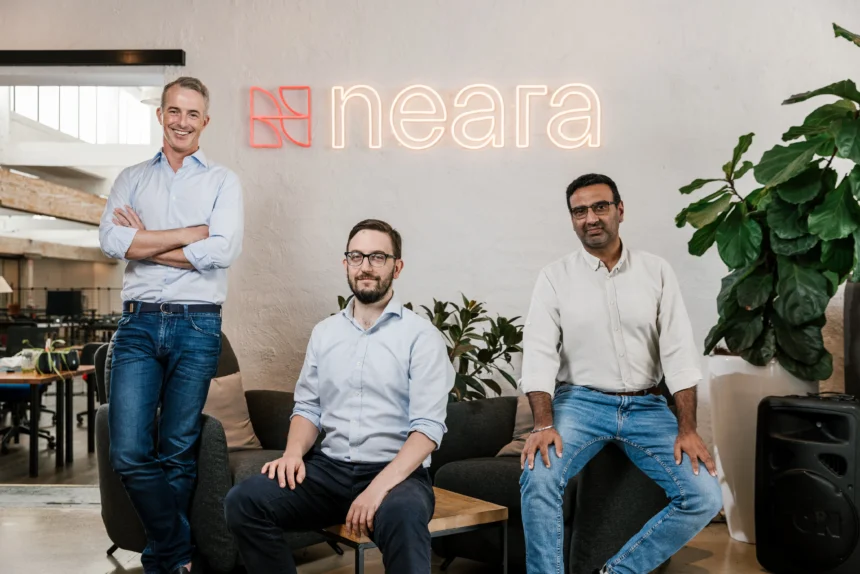
The founder and early leadership narrative is also unusually candid. Neara’s own story page explicitly names Dan, Karamvir Singh and Jack Curtis as the founding commercial and product voices shaping the company, with quotes from each explaining how the business evolved from design tooling into something much broader around resilience, infrastructure transition and climate stress. That matters because Neara does not read like a company that reverse-engineered a pitch deck; it reads like one that got smarter as it got closer to customers.
The growth funding history reflects that expanding relevance. In October 2024, Neara announced a US$31 million Series C, later covered as about A$45 million, to accelerate international growth and vertical expansion. Then, in 2026, it reportedly raised a much larger Series D led by TCV. I am including it here because the Series C was the defining growth milestone that pushed the company into global scale mode, and the subsequent D only reinforces the quality of the underlying business.
What gives Neara unusual weight is the clarity of the platform’s use case. The company describes itself as an AI-powered predictive modeling and physics-enabled digital twin platform for critical infrastructure, particularly utilities. Its marketing and product pages are not vague about the applications: vegetation management, flood management, storm response, asset health, hardening decisions and safe restoration planning. This is a company selling infrastructure intelligence in one of the world’s most urgent sectors, not a generic digital-twin abstraction.
The partner and customer ecosystem is what makes the story especially strong. Neara’s press and capability materials reference work with CenterPoint Energy in the US, Endeavour Energy in Australia, ESB Networks in Ireland, and SPEN and SSEN in the UK. The company also said utilities using its platform identify outage risks 9x faster, restore power 3x faster, and reduce field visits materially. These are the kinds of operator-facing claims that make the business feel tied directly to grid resilience and infrastructure safety rather than to a softer “innovation” narrative.
That real-world utility context is critical. Neara is scaling at a time when grids are being pushed by extreme weather, ageing infrastructure, electrification and AI/data-centre energy demand. Its latest funding coverage explicitly tied growth to the need for utilities to modernise and understand their networks more deeply. That macro tailwind is especially valuable because it is not cyclical consumer appetite — it is structural infrastructure necessity.
The challenge for Neara is that it now operates in a mission-critical environment where expectations are high and delivery stakes are real. Utility sales cycles are long, implementations are complex, and the company has to maintain scientific and engineering credibility at scale. But that is also why its progress matters. Neara has moved from a founder’s side project in design software to a global infrastructure-intelligence platform whose customers are among the most operationally demanding organisations in the world.
For a Startup Australia showcase, Neara is one of the most satisfying examples of a local company growing into something structurally important. It combines founder authenticity, strong product-market fit, a large Series C and later scale financing, and a business case that is deeply tied to resilience, safety and decarbonisation. It is not flashy in the way consumer startups often are, but it may be one of the more consequential companies in the cohort.